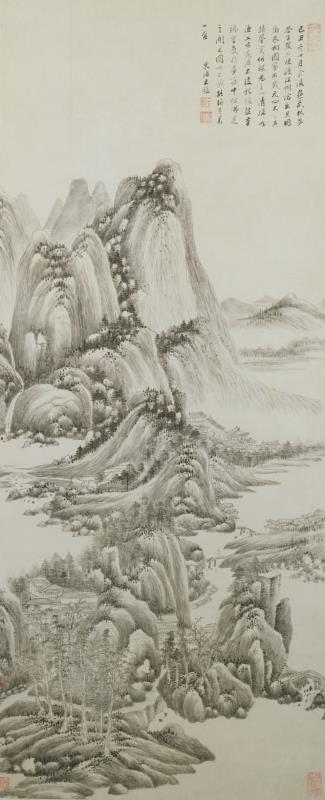
After the Spirit of the Four Yuan Masters
Introduction
Wang Jian's masterpiece, After the Spirit of the Four Yuan Masters, intricately captures the profound essence of the four eminent painters from the Yuan Dynasty: Huang Gongwang, Wu Zhen, Ni Zan, and Wang Meng. Crafted during the Qing Dynasty, this painting stands as a testament to Wang Jian's deep reverence for and emulation of the distinct styles of the Yuan masters.
Composition and Aesthetic
Measuring 130 centimeters in height and 53.5 centimeters in width, the artwork embodies a sparse yet tranquil composition reminiscent of the literati painting style prevalent during the Yuan Dynasty. Wang Jian's deft brushwork is evident in the elegant contours of the mountains and rocks, as well as the intricate interplay of ink dots, creating a harmonious atmosphere of "indifference and delight"—a hallmark of Yuan landscape artistry.
Artistic Depth and Interpretation
After the Spirit of the Four Yuan Masters transcends mere imitation by seamlessly fusing the distinctive styles of the Yuan masters. Wang Jian's creative vision was significantly influenced during his encounters with the original works of the Yuan masters. Inspired by this immersive experience, he skillfully transformed his admiration into a dreamlike interpretation that encapsulates the spiritual essence of the Yuan masters. The painting exemplifies Wang Jian's fusion of traditional techniques with innovative expressions, showcasing his adeptness at incorporating new dimensions into the classical realm of Chinese landscape painting.
Cultural Reverberations and Enduring Influence
Regarded as a pinnacle in Wang Jian's artistic legacy, After the Spirit of the Four Yuan Masters showcases his adeptness at not only replicating but also reinterpreting the artistic legacies of the past. Serving as a bridge between the Yuan and Qing dynasties, this masterpiece symbolizes the seamless continuum and evolutionary trajectory of Chinese painting traditions. It stands as a precious artifact, offering profound insights into the artistic dialogues spanning different eras and highlighting the enduring legacy of the Yuan masters on subsequent generations of painters.








